
Stratford-upon-Avon Then and Now
Read moreShow less
Stratford-upon-Avon's name is Anglo-Saxon and entirely literal — a "street ford," marking the point where a road crossed the River Avon — and a monastery is thought to have stood on or near the site of Holy Trinity Church as early as the 7th century, though the settlement itself remained little more than a village until the Normans arrived.
Its real founding moment came in 1196, when King Richard I granted a charter permitting a weekly market, following the clearing of the Forest of Arden and a rise in local agriculture; by 1252 the young town had around 240 citizens, shops, and stalls, and merchants formed the Guild of the Holy Cross in 1269 to oversee its trade and religious life. Stratford prospered through the wool and glove trades over the following centuries — Sir Hugh Clopton, a Stratford-born mercer who became Lord Mayor of London, funded the stone Clopton Bridge across the Avon in 1462, still in use today — and the Guildhall was built in 1418, from where the Guild administered the town until the Reformation ended its powers in 1547. Edward VI re-founded the grammar school and incorporated the town as a borough in 1553, and it was into this modest, well-connected market town that William Shakespeare was born in April 1564, the son of glover John Shakespeare, in the Henley Street house that still stands.
Despite its famous son, Stratford grew little between his lifetime and the early 19th century — plague struck in 1564 and again in 1645, and the town suffered further during the Civil War — but a wave of practical improvements finally arrived from the 1810s onward: a canal opened in 1816, gaslight in 1834, a railway connection in 1859, and a sewer network through the 1850s, all of which made the town far easier for admirers of Shakespeare to reach.
Victorian civic pride and tourism money transformed Stratford's relationship with its most famous resident: his birthplace was preserved as a public monument in 1847, and the Shakespeare Memorial Theatre — rebuilt as the Royal Shakespeare Theatre after a 1926 fire, with the current building completed in 1932 — turned the town into the permanent home of world-class Shakespearean performance, cementing an identity that today draws millions of visitors a year to a town whose medieval market-and-guild origins still shape its street plan.
The TV Cozy Crime series Shakespeare and Hathaway is set and filmed in Stratford-upon-Avon.
Discover the history of Stratford-upon-Avon through our local archive. This section currently includes 2 historical photos in Stratford-upon-Avon, with source imagery connected to place and context.
Explore historical photos for Stratford-upon-Avon. Browse source images and location-based visual history from the GhostViewer archive.
Open the images to view more information, then load them into the GhostViewer app.
📸 Turn These Old Photos into a Real-World Adventure
Want to see these historic backdrops with your own eyes? Discover the best walking and cycling trails in Stratford-upon-Avon. Open AllTrails to unlock local route maps and walk through history on your next outing.
Date range: 2019.
Partner provenance: 2 linked partners for this location.
Partners: Photo Walk UK, RW Jemmett.
Memories of Stratford-upon-Avon - read and add your own.
No memories have been shared for this place yet.


Preston Bagot Lock 36 – Stratford Upon Avon Canal
Stratford-upon-Avon items on eBay
-
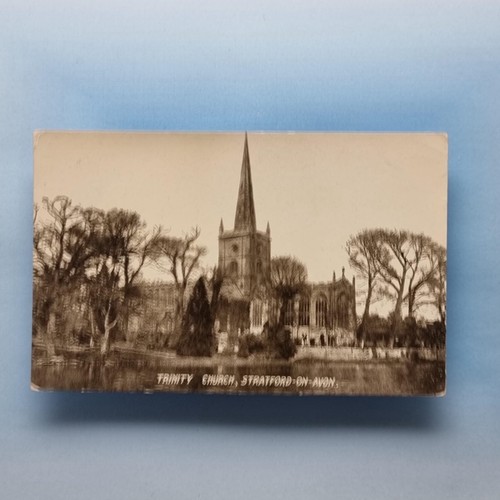 Stratford Upon Avon Postcard 1919 Warwickshire Local Parish Church & Grounds
Used
-
 RPPC Stratford-upon-Avon Aerial View Postcard c1953 Otley (AE1118)
Used
-
 STRATFORD-UPON-AVON Shakespear's Birthplace Postcard - ref S29
Used
-
 Postcard - Stratford upon avon - view of the high street
Used
-
 Vintage Postcard Shakespeare's Birthplace Garden Stratford-Upon-Avon c1910s
Used
-
 Stratford-upon-Avon Shakespeare's Birthplace Kitchen Fireplace Postcard 550
Unspecified