If you work in heritage, conservation, or historic preservation — or you simply care about protecting the built and natural environment — then the GhostViewer App was made for you, even if you didn’t know it yet.
This is a tool that shows time passing. And for anyone whose work is about understanding, documenting, or defending places that matter, that is a remarkably powerful thing to have in your hands.
Documenting What You’re Trying to Protect
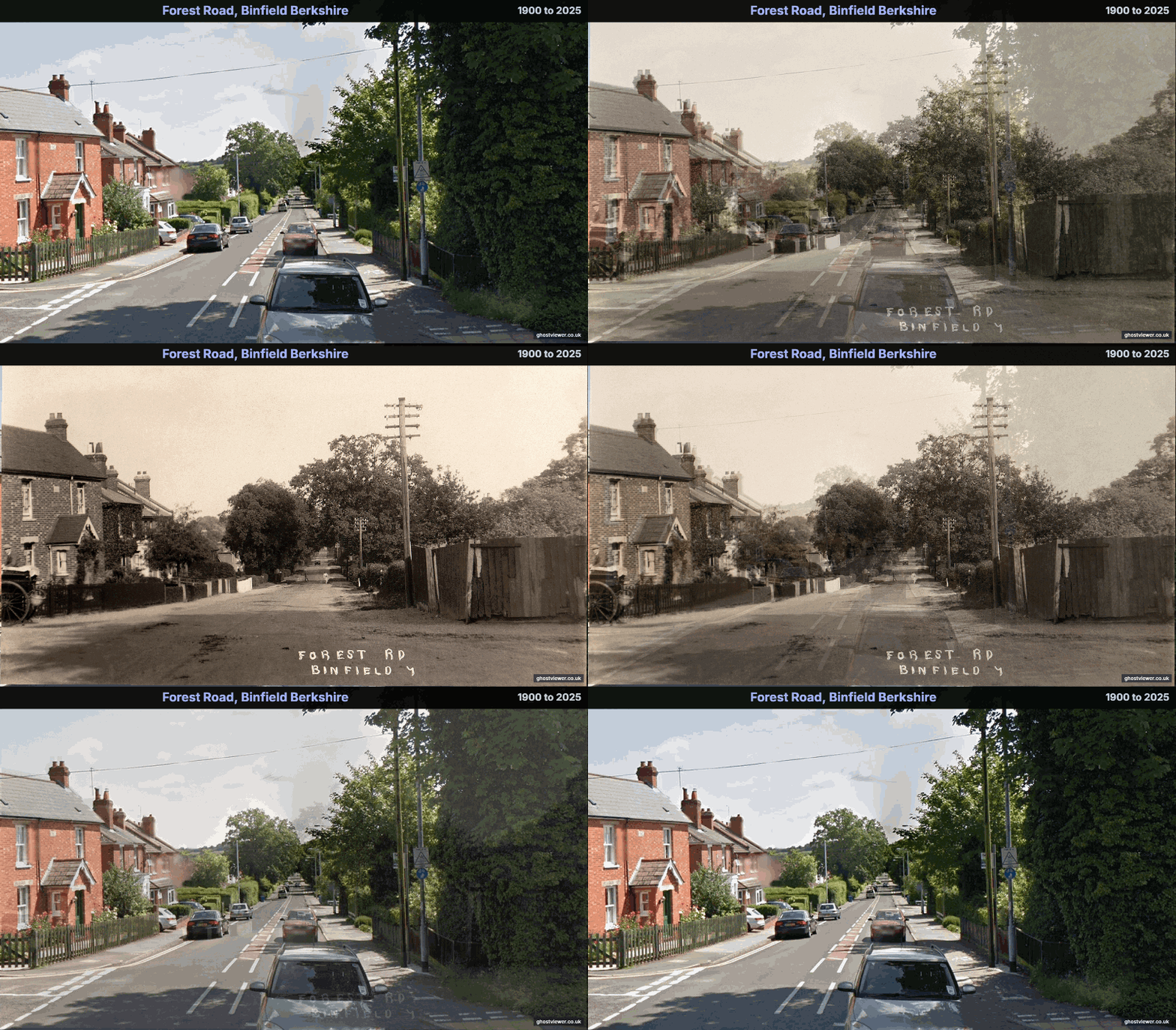
The most immediate use is the simplest. Find an old photograph of the building, street, gasometer, or stretch of coastline your group cares about. Take a modern photograph from the same spot. Align them in GhostViewer and you have something that no planning application, committee report, or press release can match — a direct visual comparison that anyone can understand in seconds.
Change that would take paragraphs to describe becomes obvious the moment you see it. So does continuity. If a Victorian terrace has survived largely intact, showing that visually makes the case for protection far more powerfully than words alone.
Click to view in Lightbox:
Forest Road Binfield Berkshire, England
c. 1900 to c. 2025
Gasometers, Power Stations and Industrial Heritage
Some of the most visually dramatic rephotography subjects are industrial, and some of the most important conservation battles are being fought around them.
Gasometers are a perfect example. Many are now Listed Buildings, recognised for their extraordinary engineering and their role in the development of Britain’s towns and cities. An 1890 photograph of a gasometer still standing today, aligned with a modern image, tells the complete story of a structure that has outlasted almost everything built around it. That story resonates with the public in a way that a listing description never quite does.
The same applies to Victorian waterworks and pumping stations, mill buildings, railway infrastructure, power stations, and the remains of collieries. Every one of these has communities and organisations fighting for their survival — and every one of them has an archive of historic photographs sitting largely unseen.
Coastal and Landscape Change
For environmental conservation groups, GhostViewer offers something particularly valuable — the ability to show gradual change that is otherwise invisible to the human eye.
A cliff photographed in 1920 and again today. A beach before and after managed retreat. A woodland that has grown back over a former industrial site. A stretch of moorland before and after rewilding. These comparisons are scientifically valuable, publicly engaging, and deeply compelling when shared on social media.
Natural England, the National Trust, wildlife trusts and coastal management groups already commission systematic repeat photography for monitoring purposes. GhostViewer makes that process accessible to any volunteer, ranger, or community group with a smartphone and a historic photograph.
Making Your Archive Come Alive
Most heritage organisations have archives. Boxes of prints, collections of glass plates, albums donated by local families, postcards acquired over decades. Much of this material has never been seen outside the organisation.
GhostViewer gives you a reason to dig it out — and a way to share it that feels immediate and relevant rather than dusty and academic. Publish a historic photograph from your collection. Invite your members, your social media followers, or the wider public to go and photograph the same spot today. The response will surprise you.
This is not just engagement for its own sake. It builds a living record of place and change that your archive alone could never create. Every matched pair is a new piece of documentation, contributed freely by people who care.
Planning Objections and Historic Evidence
If your organisation works on planning matters, then historic photographs are already part of your toolkit. GhostViewer adds a layer of visual persuasion that static images cannot provide.
A before-and-after alignment showing the character of a street that would be affected by a proposed development. A sequence showing how a building has changed — or stayed the same — over a hundred years. These outputs can be included in consultation responses, presented at planning committees, and shared with local media. They make abstract arguments concrete.
Working With Schools and the Next Generation
Heritage organisations that work with young people will find GhostViewer genuinely useful in an educational context. The Ghost Guide Camera feature — which overlays a historic photograph on your phone’s live camera view — turns a local history walk into something that feels more like a treasure hunt than a classroom lesson.
Send a group of students out with a set of historic photographs from your collection and ask them to find the exact spot, align the view, and take the modern photograph. The engagement is immediate. The results are theirs — and the connection to local history is made through doing rather than being told.
How to Get Started
You don’t need a large archive or technical knowledge to begin. Here’s a simple first step:
- Find one good historic photograph of a place your organisation cares about — a postcard, a print, a scanned image from your collection
- Visit the location and take a modern photograph from as close to the original viewpoint as you can manage
- Open GhostViewer in your browser — no account needed
- Upload both images, match four or more corresponding points, and align them
- Export as a still image, an animated GIF, or a video
Share the result with your community and see what happens.
Share Your Creations
If you create something you’re proud of — a dramatic industrial comparison, a landscape that shows decades of change, a building that has survived against the odds — share it with the GhostViewer community. Tag it with your location and organisation. These are exactly the images that inspire others to go out and do the same.
The GhostViewer App is free to use. Everything happens inside your browser — your photographs are never uploaded to any server.
Built for places. See through time.
Have an archive you’d like to share with the GhostViewer gallery? We’d love to hear from you — get in touch via ghostviewer.co.uk